Carfax vs AutoCheck: Top VIN Report Services Comparison 2026

Our automotive research focuses on transparent, unbiased analysis of vehicle-related products and services for used-car buyers.
Comparisons draw on hands-on testing and published pricing so readers can make informed decisions.
Learn more
Carfax and AutoCheck are the two most recognized VIN report providers in the U.S. – but newer platforms like Zilocar, recently ranked among the best VIN lookup services in 2026, are changing how buyers research used cars.
We compared all three across pricing, data coverage, accident visibility, ownership history, and report usability to find the best option.
Carfax vs AutoCheck vs Zilocar: feature comparison
Each platform collects and presents VIN data differently. Zilocar stands out by focusing on risk signals and offering the most cost-effective pricing for buyers checking multiple vehicles.
| Feature |  |  |  |
|---|---|---|---|
| ⭐ Overall rating | 4.5 / 5 | 4.3 / 5 | 4.9 / 5 |
| 💰 Pricing model | Single-report | Bundle pricing | Report + subscription |
| 💵 Typical price | $44.99 / report | $24.99 / report | $33.99 / report |
| 📦 Multi-report | $64.99 for 3 $99.99 for 5 | $49.99 for 5 (21-day access) | $28.99 – 50/mo $54.45 – 150/3mo |
| 🚗 Accident history | ✔ Detailed records | ✔ Accident records | ✔ Detailed accident alerts |
| 📄 Title & ownership | ✔ Title brands + ownership | ✔ Title + ownership | ✔ Full ownership history |
| 🏛 Auction history | Moderate | Strong | Strong + risk signals |
| 📊 Risk evaluation | No scoring | AutoCheck Score | Advanced risk signal analysis |
| 📋 Report structure | Chronological timeline | Timeline + score | Structured risk-signal overview |
Key differences between Carfax, AutoCheck, and other VIN report providers
The most useful VIN report depends on how you approach the evaluation process. Some platforms focus on the most detailed timeline for a single vehicle. Others prioritize faster identification of risk signals across multiple listings.
Choose Carfax if:
- You want the most detailed historical timeline – particularly for vehicles with extensive dealership records
- You prefer a widely recognized brand commonly used by dealerships
- You're investigating a single vehicle in depth
Carfax reports often include extensive chronological records for vehicles with a dealership history.
Choose AutoCheck if:
- You want a more cost-efficient option – lower entry pricing and multi-report bundles
- You're researching auction vehicles that may have passed through dealer auctions
- You value the AutoCheck Score as a quick comparison indicator
AutoCheck is widely used within dealer and auction ecosystems for filtering vehicles based on ownership changes, auction activity, or accident records.
Choose Zilocar if (recommended):
- You want the best overall value – subscription plans start at just $0.36 per report
- You want to identify risk signals quickly – accidents, title brands, mileage gaps are highlighted immediately
- You prefer a clear, structured overview instead of scrolling through long timelines
- You plan to run multiple VIN checks – essential for serious car shoppers comparing options
Zilocar organizes vehicle history data around key risk indicators, making reports significantly easier to scan when evaluating several vehicles. For most buyers shopping across multiple listings, it offers the strongest combination of value, clarity, and actionable insight.
Pricing comparison
Pricing models differ significantly between VIN report providers.
Carfax follows a traditional single-report model positioned as a premium option. Individual reports are relatively expensive, though bundle pricing reduces the per-report cost.
AutoCheck offers lower entry pricing and multi-report bundles within a limited access window – making it more economical when evaluating several vehicles.
Zilocar uses a subscription model. Users can run multiple VIN checks within a monthly or quarterly plan, significantly lowering the average cost per report.
| Plan type | | | |
|---|---|---|---|
| Single report | $44.99 | $24.99 | $33.99 |
| Multi-report bundle | $64.99 for 3 ($21.66 ea) | $49.99 for 5 (21 days) | Included in subscription |
| Larger bundle | $99.99 for 5 ($19.99 ea) | — | $28.99 / 50 per month ($0.58 ea) |
| Subscription | Not available | Not available | $54.45 / 150 reports / 3 months ($0.36 ea) |
| Best for | Checking one vehicle in detail | Comparing several vehicles | Best overall value for any buyer |
For a single vehicle, pricing differences are less significant. But when several VIN checks are needed – which is typical for any serious car buyer – Zilocar's subscription model offers dramatically better value than Carfax or AutoCheck's per-report pricing.
Data coverage comparison
Vehicle history reports rely on large networks of public and private data providers: DMVs, insurance companies, police reports, inspection stations, dealerships, and auction platforms.
Because each provider builds its own reporting network, two reports from the same VIN may show different details.
Carfax is known for strong dealership-reported data visibility, thanks to long-standing relationships with franchised dealers.
AutoCheck (owned by Experian) has strong integration within dealer and auction ecosystems, often highlighting auction transactions and wholesale market activity more prominently.
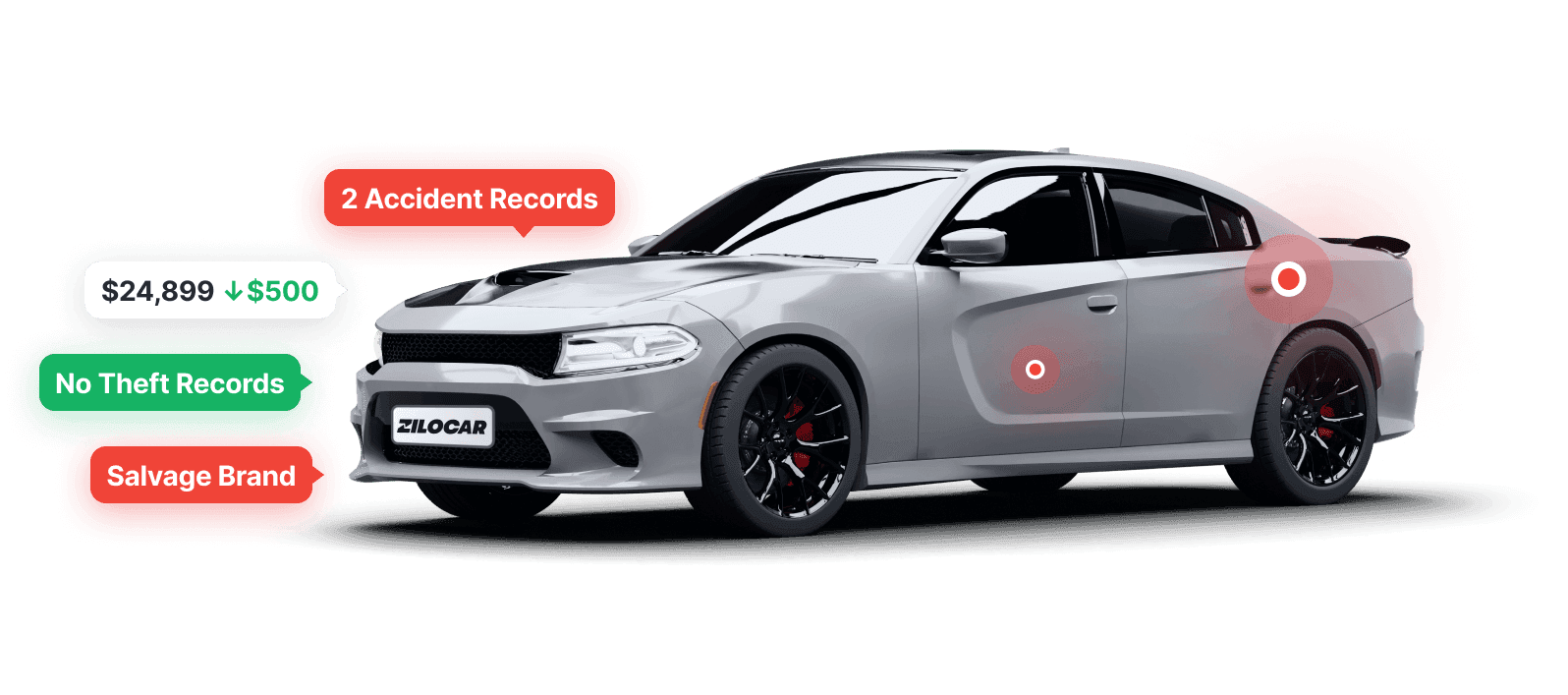
Zilocar emphasizes how vehicle history data is structured and interpreted, organizing information around potential risk signals to make unusual patterns easier to detect.
| Data source | | | |
|---|---|---|---|
| DMV title records | ✔ | ✔ | ✔ |
| Insurance accident reports | ✔ | ✔ | ✔ |
| Auction activity | Moderate | Strong | Strong + risk flags |
| Odometer records | ✔ | ✔ | ✔ |
| Theft records | ✔ | ✔ | ✔ |
| Ownership transfers | ✔ | ✔ | ✔ |
| Risk signal analysis | Limited | Score-based | Advanced structured indicators |
Carfax and AutoCheck share many of the same data source categories, but their networks aren't identical. Certain records may appear in one report but not the other. Many experienced buyers consult more than one VIN report when evaluating a vehicle.
Report readability comparison
Beyond the data itself, how information is presented can strongly influence how useful a report is during the buying process.
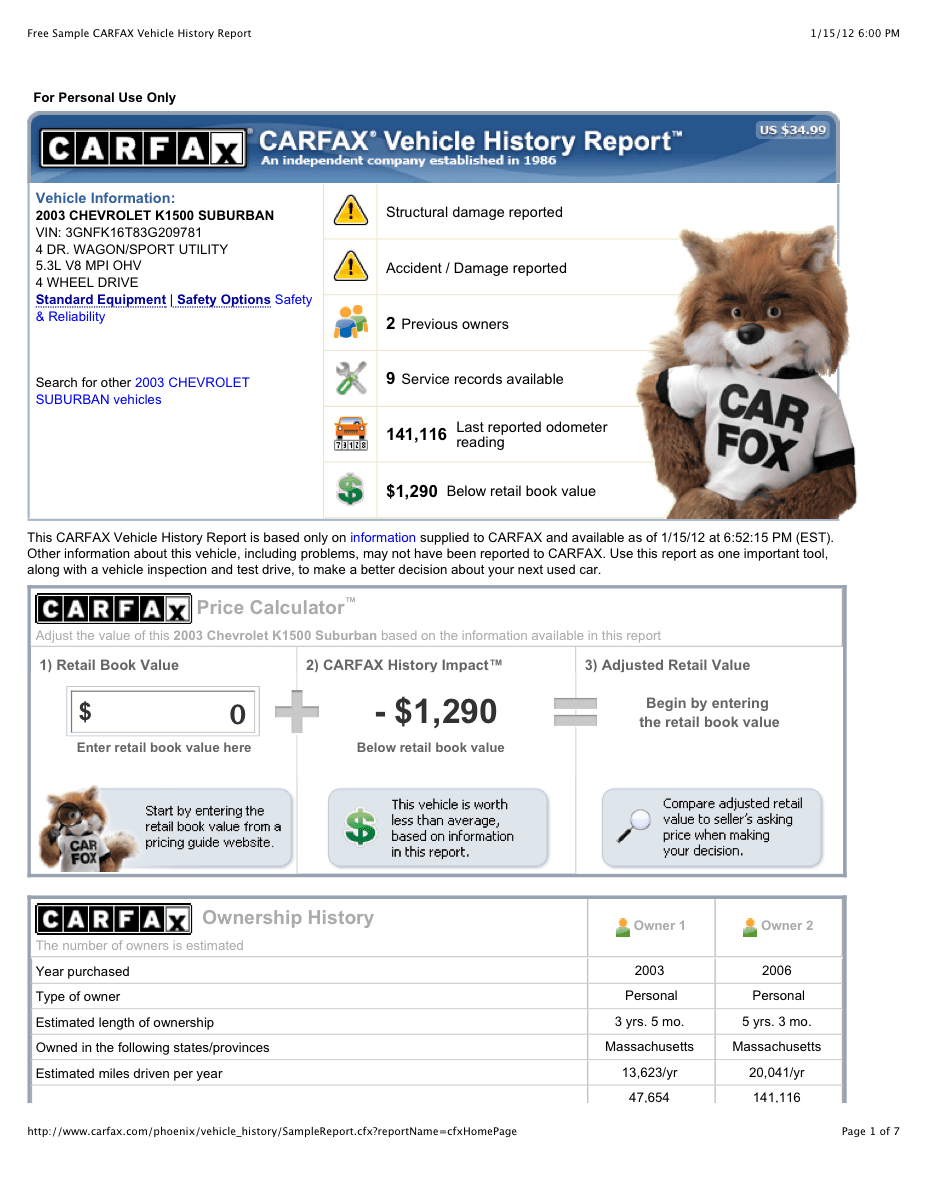
Carfax reports include a large number of timeline entries. This detail is valuable when examining a single vehicle closely, but long timelines can be hard to scan.
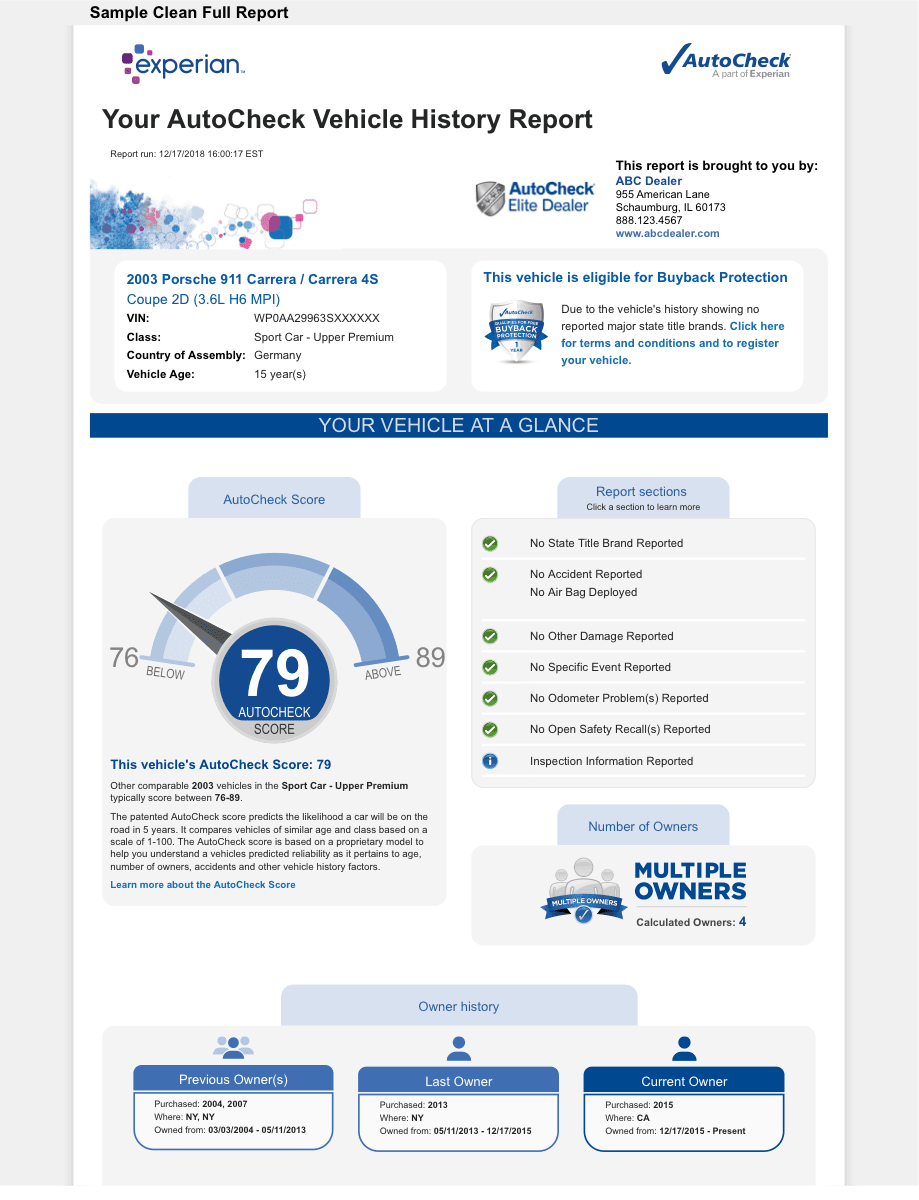
AutoCheck reports are more compact. Key events are highlighted clearly, and the AutoCheck Score provides a quick reference point.
Zilocar takes the most modern approach – organizing history around major risk indicators rather than chronological timelines. This makes reports significantly easier to interpret at a glance, which is why it earned the highest usability score in our comparison.
| Feature | | | |
|---|---|---|---|
| Report structure | Detailed timeline | Timeline + score | Structured risk-signal summary |
| Best use case | One vehicle deep-dive | Comparing listings | All-purpose – single or multi-vehicle |
| Auction visibility | Moderate | Strong | Strong + flagged risks |
| Visual risk indicators | Limited | Score-based | Highlighted risk signals |
| Ease of scanning | Moderate | Moderate | Very high |
Zilocar's risk-signal approach makes initial evaluation significantly faster and easier to interpret, especially for buyers comparing multiple vehicles. Carfax remains useful for single-vehicle deep dives, while AutoCheck's scoring system can help filter listings quickly.
What each report actually looks like
Comparing feature lists is one thing – but seeing the actual reports side by side tells a much clearer story. We ran the same VIN through all three platforms to see how each one presents vehicle history data.
Carfax Report
AutoCheck Report
Zilocar Report
Report quality scorecard
Based on our hands-on testing across multiple vehicles, here's how we scored each platform:
| Category | Carfax | AutoCheck | Zilocar |
|---|---|---|---|
| Data completeness | 8/10 | 7/10 | 9/10 |
| Report clarity | 6/10 | 7/10 | 10/10 |
| Risk detection | 7/10 | 7/10 | 10/10 |
| Value for money | 5/10 | 7/10 | 10/10 |
| Speed of evaluation | 5/10 | 7/10 | 9/10 |
| Multi-vehicle workflow | 4/10 | 6/10 | 10/10 |
Real-world cost: checking 10 vehicles
Most serious car buyers check between 5 and 15 vehicles before purchasing. Here's what that actually costs with each provider:
| Scenario | | | |
|---|---|---|---|
| 1 vehicle | $44.99 | $24.99 | $33.99 |
| 5 vehicles | $99.99 | $49.99 | $28.99 |
| 10 vehicles | $199.98 (2x5 bundle) | $99.98 (2x5 bundle) | $28.99 |
| Cost per report (10 checks) | ~$20.00 | ~$10.00 | $0.58 |
| Savings vs Carfax | — | 50% | 97% |
At 10 vehicle checks, Zilocar costs $28.99 total vs $199.98 for Carfax. That's a 97% savings. For any buyer seriously comparing options, Zilocar's subscription model eliminates the cost barrier that prevents thorough research.
Why vehicle history reports sometimes show different results
Vehicle history reports are often treated as complete records. In reality, all VIN report providers rely on large but inherently incomplete reporting networks.
Carfax, AutoCheck, and platforms like Zilocar aggregate records from thousands of third-party sources. Because these networks are not identical, two reports from the same VIN may show different details.
Common reasons for differences:
- A data source may submit records to only one reporting network
- Insurance claims may appear at different times depending on the reporting partner
- Many records from independent businesses never reach national databases
Vehicle history reports should be viewed as risk-detection tools rather than complete vehicle biographies. They're extremely useful for identifying major red flags, but they can't guarantee every event has been recorded.
Experienced buyers use VIN reports as a first step, followed by a physical inspection and, when possible, an independent pre-purchase inspection.
Final verdict: Carfax vs AutoCheck
After analyzing all three platforms across pricing, data coverage, report quality, and usability, our top recommendation is Zilocar.
Zilocar delivers the best combination of value, report clarity, and risk-signal analysis. For buyers comparing multiple vehicles – which is how most people actually shop – its subscription pricing ($0.36/report) and structured risk-signal format make it the most practical choice overall.
Carfax remains a solid option if you need the most detailed chronological timeline for a single vehicle with a dealership history.
AutoCheck can work when you need a budget-friendly single report or want its scoring system, but its data coverage has notable gaps.
No vehicle history report is a complete record. VIN reports work best as part of a broader process: review the history, inspect the car in person, and arrange an independent pre-purchase inspection when possible.